NYARA Hike-A-Thon


Authors note: Team Florida Xtreme 3 is a developmental pick-up team focused on novice racers gaining experience in running elite length courses with an experienced team captain. Race team captain is Dave "Dash" Ashley, a local racer from Merritt Island with several years of elite level racing experience and a navigator for team Florida Xtreme and Mountain Khakis/Rev3 Adventure. If you are looking to move up from the novice to elite class but would like some backup assistance the first time, drop me a line! ~Dash
Saturday January 28th welcomed 3 new racers to Team FLX-3: Jeanette, Stef, and Wesley. The 6-hour Treasure Coast AR would be the longest race yet for all three. Weather was forecasted to be sunny, low 70s, and little wind. Perfect conditions and in a perfect location, Jonathan Dickinson State Park near Hobe Sound, Florida.
Here is a quick rundown of the team:
Jeanette: Completed about 10 ARs, mostly Pangea sport races with a few of the shorter Elite events. Former soccer player and gymnist, looking to gain experience navigating. Master’s degree in Electrical Engineering, wow!
Stef: Completed about 7 ARs, Pangea sport races, also training for a marathon. Strong cyclist, looking to gain experience navigating. Very fit, killed this race physically!
Wesley: Completed 2 Pangea sport races with family/friends. Strong paddler, and looking to gain experience from racing with an elite team in a longer race. A loving husband, brings his wife to the race and sets her up in style with a tent, chair, and cooler full of cold beverages!
I was a little nervous meeting up with three strangers for a 6-hour race. Teamwork and chemistry are so important in adventure racing, this was the equivalent to going all in and not even looking at your poker hand! Well, live a little, right?
Things started off pretty well, as I showed up to the race registration about 15 minutes late and was able to locate all three of my teammates after a few minutes.
Lesson learned: Plan to arrive early. The directions only put us at the front gate of the park, the race start area was another 10 minute drive from there! We lost valuable time that could have been spent analyzing our maps.
After gathering all of our gear into one spot and snagging one of the few picnic tables, Jeanette and Stef started looking over the maps and clue sheet. Since this was Wesley’s 3rd race, we spent some time going over some race fundamentals such as what gear was needed and how to pack for a 6 hour race, options for hydrating and fueling, differences between canoe and kayak paddles (we brought kayak paddles for this race), and some of the key differences between the many types of mountain bikes.
From left to right: Stef, Wesley, and Jeanette
Jeanette used a cool tool I had never seen before. Using a small piece of colored wire, she would bend the wire into the shape of a trail on our map to measure between two checkpoints. Marking the length with her finger on the wire, she would then straighten the wire and measure the distance off the map scale. It was quick and easy to measure the distance between two points, even if the route curved back and forth. As we would soon find out, our “map” only showed about half the trails that were actually out in the park. If we didn’t know the distance to travel and use a cycle computer or pace count to measure, we could have easily gotten lost. Nice work Jeanette!
Lesson learned: Don’t trust your map to show all the roads and trails. Measure your map and keep track of your distance, this will help reduce the possibility of turning too early or missing your turn. Some racers use different techniques, such as a string, a mechanical or digital measuring tool, and some experienced navigators can eyeball distance accurately.
After working the map, red shows our travel path and distances
The Treasure Coast Elite AR was composed of 4 sections. All teams must first do a short (~3k) trek, followed by a moderate (~10k) paddle. After that, teams had to accomplish both a moderate (~10k) trek and long (~20k) bike but could pick the order, either bike/run or run/bike.
Stef started off navigating, and Wesley was our “rabbit” and had the job of punching our passport at the checkpoints. The first trek was entirely on a nature trail and was very straightforward, with the typical “choo-choo train” of 16 teams heading off in the same direction. Stef masterfully navigated us through this section.
Race start, noticeable "choo-choo train" of teams
Following the short trek, we sped through transition and grabbed our kayak paddles. There was a short line to launch canoes, then we were treated to a beautiful paddle through mangrove-lined waterways with glassy conditions. Jeanette flawlessly lead us through this section, while Wesley and Stef showed off their paddling skills.
In line to launch canoes
Lesson learned: We all had kayak paddles, and it paid off. We were faster than teams with canoe paddles. The wide channel and relatively little overhanging vegetation was perfect. If the waterway was narrow, or had more overhanging trees, canoe paddles would have been the better choice. Bring your own paddle to the race, and make the decision once you see the park and map.
We opted to avoid congestion with the flotilla of other canoes in the narrow sections of the creeks, and went back to the furthest checkpoints first. That strategy rewarded us with some quiet time on the water where we didn’t see any boats, and we were able to gauge how fast other teams were moving as they passed us on our way back to catch the earlier points. We easily found all the points and were quickly back at the main transition area.
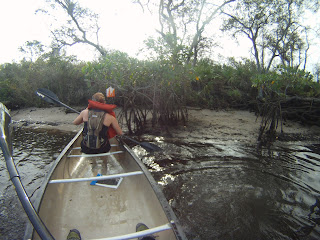
Snagging a paddle point
Lesson learned: Often, paddles are “out and back” and some of the points along the way you have the option of getting now, or when you return. Keep an eye on them as you go and grab them if convenient. If other teams are clogging the shore, or you don’t see a point the first time you go past, it’s often easier to get it and/or see it when you are returning the other direction. So don’t sweat missing one if you can grab it on the return trip!
Next we had the option of the long bike or moderate trek. We elected to bike first, and with another quick transition (great job team!) we headed off with Stef navigating, Jeanette marking distance on her cycle computer, and me rabbiting.
Not nearly as much sand as FLX-3 encountered in the Resolution AR, JD Park certainly had some of the deep stuff out there. Most of our checkpoints were right off trails, but far enough that you had to know where to look. And there were a maze of trails that didn’t show up on the map, while some of the map trails were incorrectly marked. A typical adventure race!
Stef did a great job of keeping us in a “known” location for most of this section. He communicated with the rest of the team when he was not sure, and several times Jeanette, Wesley and I were able to help keep the team on track. With a little bit of luck and a brazen bikewhack move that paid off, we finished the bike portion and moved up the leaderboard several positions over other teams. At this point we had about 90 minutes left to race, the temps were warming up, the sun was beating down, and we were all getting tired. Time for a 10-k sand run!
Lesson learned: The navigator should regularly communicate with team members and use their eyes to help locate key terrain features. A strong navigator will let the team know how far until the next turn or checkpoint, which direction they should be heading, and any other details that will help the team stay in a “known” location while racing. Team members should all know how to use a compass, pacecount, and have a cycle computer with an odometer set in kilometers. This philosophy saved us several times during the Treasure Coast race.
With a slightly slower transition to remove some of the bothersome burrs that we collected during the bikewhack, team FLX-3 headed out for the last leg. We already knew that time was short, we were tired, and any serious navigation error would cost us a point at a minimum, and likely several slots in the overall placement as well. Only 10k to go!!
Stef was handling the long race and heat well, so after a quick huddle we elected him the navigator for the final section. I rabbited and counted pace. Jeanette and Wesley were both getting winded, and worked together motivating each other to keep pushing. While nobody was severely worn out, we discussed things a team could do when one team member “hits the wall”. Stef had a tow rope that we practiced with, while Wesley experimented with holding on to the pack straps of the person running in front and slightly to the side for some extra speed. Even with a pace count we had difficulty finding two of the three points, but ended up with a full control card and headed back to the finish with only minutes to go.
I dare you to bushwhack through saw palmettos!
Lesson learned: Teams must stay together at all times in adventure racing, so you are only as fast as your slowest member. Pair up your strongest paddler with your weakest. Provide a push on the back during straight bike sections, or carry a tow rope. If needed, you can tow on the run as well. But I only recommend this if you are close to a cut-off time on the course, or going towards the finish line. Towing on the run can easily wear out both members, so don’t do this early in a race!
Team FLX-3 completed the Treasure Coast Adventure Race in just over 5 hours 42 minutes and in 5th place overall. It was an impressive finish, as only 5 teams out of 16 “cleaned” the course with all checkpoints. Jeanett, Stef, and Wesley had just finished their longest race…ever! Their navigation was stellar, and everybody stayed positive on the course. Not too bad for 4 people who were complete strangers at 7am that morning!
Looking forward to seeing the folks from Pangea and team FLX at the Boar AR in March!
~Dash

this point we were still in the wind, very wet, and getting close to hypothermia. Time for a short team discussion. Should we continue the race? Should we cut short the paddle section? Everybody had a different opinion. In the end we discussed the team goals...no stopping with time and CPs still on the course! So much for an "easy" adventure race.
Oak Hill, WV
June 24-26, 2011
Photo By Chris Radcliffe of Mad Race Media
Race Report by Terri Spanogle
River Boarding – 4 miles
Paddling – 30 miles
Trekking – 35+ miles
Mountain Biking – 70-80 miles
Off-Trail Orienteering – 23 mandatory checkpoints; optional orienteering course
Dennis and I packed my car full of gear and food and headed out for a 5.5-hour drive to Southern West Virginia Thursday afternoon. We met up with our teammates, Ernie and Fritz, after their 11-hour drive from Connecticut at the cabin where we were staying at the Ace Adventure Resort. Racer check-in was at 6:00 am Friday so we needed to hustle to get our gear organized and in bed at a decent time. I maybe got 2 hours of sleep that night as I was filled with anxiety and fear of this race.
The race consisted of approximately 150 to 200 miles of trekking, mountain biking, river boarding, paddling, and off-trail orienteering in the beautiful Allegheny Mountains. The race was unsupported so teams had to carry all their gear and food (weighing approximately 15 to 20 pounds) with only one opportunity to come back to headquarters to restock our packs from our gear bin (including water).
Thunderstorms rolled in the night before so the trails were plenty muddy in spots. Otherwise, we were fortunate to have fairly pleasant weather except on Sunday when it was much cooler (not comfortable when you are soaked with sweat) in the morning with a chilling down pour towards the end of the race.
Race briefing was at 9:45 am. I’m getting more nervous. I don’t understand half of what the race director is instructing us to do. The race started with the river boarding section on the New River Gorge so we donned our wetsuits, loaded our gear, and were on the bus by 10:45 am for a one-hour ride to the start.
The water temperature was surprisingly pleasant. I fully expected it to be cold so I was prepared with my new dive suit. The Class 1 and 2 whitewater rapids were a blast! But in slow moving water the boogie boards Dennis and I were using sucked so we (me especially) were constantly falling behind Ernie and Fritz who were on proper river boards. We needed to move faster. Ernie and Fritz positioned their boards long ways so that I could hang on in the middle. Dennis is now stuck with an extra board in addition to wearing improper swimming pants that filled with water and created an annoying drag. After 2 hours of river boarding it was time for the kayaking section.
Paddling sucks. After 3.5 hours (about 20 miles) of it in mostly flat water I could feel the blisters starting to form on my hands even while wearing gloves (well cycling, not paddling gloves – I’m JV at this). The Class 1 and 2 whitewater rapids were always exhilarating to go through especially the “Surprise Rapids” (must have been a Class 3) toward the end that tossed Dennis and Fritz right out of the boat. Pretty cool to watch but scary to see them floating in the water with their boat capsized. Ernie and I managed to get through it without being flipped. So exciting! After we helped Dennis and Fritz back into their boat I looked back to see another team being flipped over by the rapids. Once we docked we then had to carry the boats up a set of very steep steps to the top where we transitioned into dry clothes (everyone strips butt naked out in the open, there is no modesty in these races) for a >7-mile trek ahead.
We started off down a dirt road but were soon heading straight up the side of the mountain through loads of poison ivy. There was no avoiding it. This was the first of many leg-burning climbs and bush whacking we would experience throughout the race. Ernie was our superb lead navigator with Fritz as deputy. Both did an excellent job of plotting and locating the checkpoints but it wasn’t easy. Sometimes we were spot on, other times we were off and wandered in the wrong direction and had to either back track or find another route but Ernie and Fritz did an excellent job and they always found the CPs as was the case for the remainder of the race.
Once we arrived back at headquarters slightly after 9:00 pm, we loaded up our packs with all the gear and food we would need for the rest of the race (39 hours to go!) and set out on the mountain bikes for about 20 miles. Ahh, mountain biking feels natural. I’m liking this now. We rode up long steep dirt and fire roads, single track, and paved roads with plenty of hike-a-bike. The descents were also long and ridiculously fast. We located all of the checkpoints as we rode through the darkness and still of night, the sky filled with stars. It was peaceful except for the many dogs that barked at us incessantly (a few even chased after us) as we rode by homes that were sparsely scattered around the mountains (it would seem none of the townies keep their dogs indoors).
We arrived at the bike transition area around 6:00 am where we were greeted by volunteers. Unfortunately they had just run out of coffee. We’ll just have to make do with our caffeine tablets, which by the way only help up to a certain point of exhaustion and just make your belly hurt and feel queasy as Dennis and I will attest to! Back up up up the mountain we go on the next trekking portion (about 12 miles). After some serious bush whacking through thick foliage on the mountain we made it down into the valley and continued our long walk on a dirt road to the river to the paddle put-in. We were all running out of water and there were no stores or water sources in site other than the creek, and we had many miles to go. As we meandered through a small section of homes down in the valley we saw a lady on the porch of a church. We asked her for some water and she gladly welcomed us in. What a blessing! I think she was ecstatic to have company in that remote area! All of the WV locals we encountered were so friendly to us and interested in what we were doing out there.
Here we go again with the most dreaded part of the race. Back in the boats for a 2-hour paddle (10 miles) down the Gauley River. The water was much colder than the day before so we were grateful there weren’t many rapids to soak us. We all agreed a 10-minute nap was in order so we closed our eyes and let the boats drift slowly down river. It’s amazing what a short nap will do for you. Now let’s get this paddle section over with. The boat take-out was in a small town where the 3 big rivers converged. We changed clothes, grabbed our gear, and off we went for the longest trek of the race (approximately 15-20 miles). Here is where my troubles began and details of the race get blurry. We’re only half way through the race.
As we started walking back up the mountainside my feet really started hurting. Dennis insisted that we stop and have Ernie (our foot expert) check them. Ernie proceeded to pad around my blisters with gauze and mole skin and even went as far as cutting out the heels of my trail running shoes to alleviate pressure (these shoes were a terrible choice for this type of race – didn’t know that you should never wear waterproof shoes when you know you’re going to get your feet soaked). Much better but still painful to walk. At this point it seemed as though we trekked endlessly on ATV trails, open fields, and through the woods. I absolutely hated this part because it hurt so bad to walk and it was hours before we made it to the bikes again. We arrived at the bike transition area a little after 9:00 pm. This time coffee and treats awaited us (and a proper bathroom across the road!).
My feet hurt like hell now. Luckily my feet didn’t hurt nearly as bad while on the bike. We headed back out on the bikes at 10:00 pm for another 60 to 70 miles and immediately started climbing back up the same mountain we had trekked earlier. It was the longest, steepest, hardest climb I think I’ve ever done. Back onto single track and fire roads where we struggled to find the next CP. It took us 2 hours to finally find it. I don’t remember much about this portion except that we rode along rolling paved roads then onto some rail trail all through the night. At least it was mostly flat but with huge mud puddles occasionally throughout that spanned the entire width of the trail. We encountered lots of teams at this point. It’s cold...when is the sun going to rise and warm us up? I’m starting to doze off when we are stopped. We’re all fading. Time for our second 10-minute nap as the sun starts to rise. So on the cold road we laid to rest our weary bodies. We then continued on the paved road until reaching CP 18 around 7:00 am (2 hours before the cut-off time) where we filled up our reservoirs with creek water (praying that the water treatment drops work to destroy the illness-causing parasites).
A critical moment in the race. Do we go for a clean sweep of the course, opting for every mandatory checkpoint (23 of them) or skip 2 of them and short cut the course to the finish? At this point in the race, as long as we finish the course regardless of the number of checkpoints we get from here on out we’ll be “official” finishers and be ranked but is it possible we could get them all within the remaining time and improve our standing in the race? Of course, being the weakest one on the team, the decision was up to me. If we go for all remaining mandatory CPs, we’ll be on the course for another 5 hours. If we short course it, then probably another 3 hours. Ernie and Fritz wanted to finish the course but completely understood if I decided otherwise. Dennis was neutral because he sensed that I wanted to short course it. I am the one hurting the most, can barely walk, and quickly losing mental focus and motivation. I was ready to get this race over with. I flip flopped, not wanting to let my teammates down, trying to be even tougher than I really am yet I had had enough and needed to be honest with myself and my teammates. Here come the tears (I can’t believe I didn’t break down sooner). I don’t give up easily and will suffer and endure but I knew it would be a big risk to make it to the finish on time if we tried for all remaining 4 CPs. We would have had to haul ass and the best I could do at that point was (even more) slow and steady. So I said to Ernie “I don’t have another 5 hours in me.” Okay, time to press on, let’s get these last 2 CPs and be done. Little did any of us know at that point that we would indeed be on the course for another 5 hours anyway! We probably would not have gotten all 4 remaining CPs so I believe it turned out to be a good call after all.
Next up is a 3,300-foot climb to the top of the mountain. At one point along the way we took a wrong path and headed back down the mountain. While bombing down the fast semi-rocky descent, I flatted. So Ernie and Dennis put my spare tube in and off we went a little further down before realizing it wasn’t the right way. Oh hell, we gotta go back up the way we came? It wasn’t rideable in spots so Dennis took my bike so that I could walk more efficiently (one of the many times he helped me along the way). We got back on the right dirt road and continued our ascent to the top. Once there and checkpoint found we were all relieved to soon be descending back down and then we had only another few miles to the finish. We have only 2 hours left before the race finish time of 1:00 pm. We can do it but we’ll need to fly down the mountain and not let up until the end. So as we were flying down as fast as we could taking big risks it started to rain. None of us had on rain gear or warm clothes and we weren’t about to stop until we got down. The descent took over 30 minutes and we were soaking wet and freezing! Once at the bottom of the mountain, I put on my rain jacket and wool base layer and quickly warmed up. I was not about to get hypothermia!
Okay, we need to seriously hustle to get back on time. We ended up on the wrong side of creek and rather than back track we cut through a section of the creek with big boulders. Again Dennis took my bike across the creek and part way up the slippery trail until I could get back on and ride. Our effort was intensifying with less than 2 miles to go. Ride as hard as you can! We made it off the single track and onto a dirt road where Fritz towed me to the finish line. We made it in at 12:30 pm with a half hour to spare!
But it’s not over yet. One of the volunteers informed us that we were in 4th place in the 4-person co-ed category but could move up to 3rd if we were to get one bonus checkpoint on the optional orienteering course. Earlier we decided we weren’t going to go for the optional CPs on the O course due to time constraints. But we were pumped with adrenaline and decided it was worth a shot! So Ernie quickly plotted the first CP and off we ran (well I fast crawled it) back up a steep hill. We had less than 15 minutes to find the CP and get back by 1:00 pm. Along the way, Dennis ran into a bee’s nest and got stung on the chin. I was lagging behind (as usual) and was bitten by a spider on my finger. We got the checkpoint, punched our bands, and back down the precipitous terrain we went with only 5 minutes to spare. We weren’t going to make it with my crippling feet and my overwhelming fatigue so Fritz put me on his back and carried me the whole way back down! It was an amazing finish and we made it in at 12:58 pm! 3rd place in the 4-person category secured, 8th overall.
As to be expected, there were plenty of trying and tough times during this race but we all kept a positive attitude (and the guys took very good care of me) and finished strong. Are the blisters, rashes, saddle sores, chafing, scrapes, bruises, sleep deprivation, sunburn, spider bite, severe muscle fatigue and exhaustion worth it? I think so. I have never felt so much exhaustion and discomfort from any type of athletic event. I’ve also never felt so much elation and pride from completing one of the hardest adventure races around with three amazing teammates. Dennis, Ernie, and Fritz are incredible elite athletes and fun to race with.